WiFi Signal Repeater
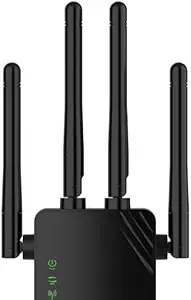
Bridging the Gap: The High-Performance WiFi Signal Repeater
In 2026, the WiFi Signal Repeater (also known as a range extender) has evolved from a simple “booster” into a sophisticated network node. As home sizes increase and building materials like reinforced concrete become more common, these devices are essential for eliminating “dead zones.”1 They work by capturing the existing signal from your main router, amplifying its power, and rebroadcasting it into previously unreachable areas like basements, attics, or backyards.2
1. In-Depth Technical Analysis
Modern 2026 repeaters utilize Dual-Band or Tri-Band technology to solve the historical problem of speed loss.3
- The Throughput Challenge: Traditionally, repeaters lost 50% of bandwidth because they used the same channel to receive and send data.4 2026 models use Cross-Band Technology, which allows the repeater to receive data on one frequency (e.g., 2.4GHz) and transmit it on another (5GHz), maintaining much higher speeds.
- Beamforming & MU-MIMO: High-end repeaters now include Beamforming, which identifies the location of your devices and directs a concentrated beam of signal toward them, rather than broadcasting in all directions.5 MU-MIMO (Multi-User, Multiple-Input, Multiple-Output) allows the repeater to talk to multiple devices simultaneously without queuing lag.6
- Protocol Support: Current top-tier repeaters support WiFi 6 (802.11ax) or even WiFi 7, providing theoretical speeds of up to 3.6 Gbps and significantly lower latency for gaming and 4K streaming.
2. User Experience & Real-World Scenarios
The user experience in 2026 is centered around “Seamless Roaming.”7
- Setup: Most devices now feature a One-Touch WPS button.8 You simply press the button on your router and then on the repeater to sync them.9 For more control, smartphone apps (like TP-Link Tether or Netgear Nighthawk) provide a visual “Spot Finder” to help you find the perfect placement.
- The “Halfway” Rule: The most common mistake is placing the repeater in the dead zone. For it to work, it must be placed halfway between the router and the dead zone, where it can still receive at least two bars of “clean” signal.10
- Aesthetic Integration: Gone are the bulky boxes with massive antennas. 2026 repeaters are often ultra-thin “wall-plug” designs or minimalist towers that blend into home decor while offering internal high-gain antennas.
3. Comparison & Market Positioning
While Mesh Systems are superior for very large mansions, the WiFi Repeater remains the most cost-effective solution for 90% of households.
| Feature | WiFi Repeater | Mesh WiFi System |
| Cost | Affordable ($30 – $100) | Expensive ($200 – $500+) |
| Installation | Plug-and-play in 2 minutes | Requires full network overhaul |
| SSID | Can share main network name | Always uses one single name |
| Best For | Single dead zones/small offices | Multi-story homes/large estates |
Market Positioning: The repeater is positioned as a “Targeted Fix.” If your WiFi is perfect everywhere except the guest room or the patio, a repeater is the logical, budget-friendly choice over a full mesh upgrade.
4. Longevity & Maintenance Pro-Tips
- Firmware is Critical: Because repeaters sit between your devices and the internet, they are prime targets for security exploits. Check for firmware updates via the manufacturer’s app every 3 months to ensure you have the latest WPA3 security patches.
- Heat Management: High-performance 600W or 800W repeaters can get warm. Ensure the ventilation slots are not covered by curtains or furniture to prevent the internal processor from “throttling” (slowing down) to cool itself.
- Reboot Schedule: If you notice the signal is connected but the internet is “hanging,” a simple power cycle (unplugging for 10 seconds) once a month clears the internal cache and restores peak performance.
Conclusion
The WiFi Signal Repeater is the most practical tool for modern connectivity. By leveraging advanced beamforming and dual-band relaying, it ensures that your high-speed fiber connection actually reaches the devices that need it. Whether you are working from a home office far from the router or streaming movies in the garden, a well-placed repeater provides a stable, invisible bridge to the digital world.11