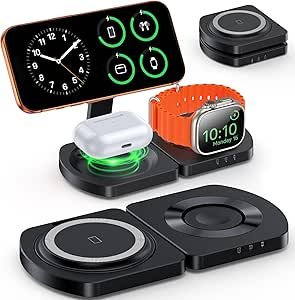
Wireless Charger – Cable-Free Power for Phones and Devices
A wireless charger is a charging device that uses inductive (or magnetic) power transfer to charge compatible smartphones, earbuds, smartwatches, and other gadgets without plugging in a cable directly to the device. Instead of inserting a cable into your phone’s charging port, you simply place the device on a charging pad or stand, and power flows wirelessly. �
endesa.com +1
How Wireless Charging Works
Wireless chargers use electromagnetic induction, typically based on the Qi standard, which is widely supported by modern devices like iPhones, Samsung Galaxy phones, and many Android models:
The charger has a coil of wire that generates a magnetic field when powered.
Your device also contains a receiver coil.
When the device is placed on the pad in close alignment, the magnetic field induces a current in the receiver, which is converted into electrical power to charge the battery. �
Gadgets 360
This means there’s no physical connector between the charger and the device’s port — reducing wear on sockets and keeping cables out of sight. �
Boomset
Key Benefits
Convenience and Ease of Use
Just place your device on the pad — no plugging in and unplugging each time. This is particularly handy for nightstands, desks, and shared spaces. �
endesa.com
Less Wear on Charging Ports
Since the cable isn’t constantly connected and disconnected, the phone’s charging port experiences less wear and tear over time. �
rebootpoint.com
Cleaner, Cable-Free Setup
Wireless chargers help eliminate cable clutter, making your workspace or bedside table tidier. �
endesa.com
Universal Compatibility
Many wireless chargers use the Qi standard, so one pad can charge different brands and models that support Qi charging. �
MOJOGEAR
Considerations and Limitations
Charging Speed
Wireless charging is often slower than wired charging, especially compared to fast wired chargers. Basic pads may deliver lower wattage (e.g., 5W–15W) compared to wired power adapters. �
endesa.com
Precise Placement Needed
For efficient charging, the device’s coil must align well with the charger’s coil — otherwise charging may be slow or intermittent. �
meter.net
Energy Efficiency
Wireless charging is slightly less efficient than wired charging, meaning some energy is lost as heat. Built-in safety features manage temperature and prevent damage, but heat can be noticeable. �
endesa.com
Types of Wireless Chargers
Charging Pads
Flat pads on which you lay your phone. Compact and simple for nightstands or desks.
Charging Stands
Angled stands that let you see the screen (useful for video calls or notifications) while charging.
Multi-Device Charging Stations
Stations with multiple zones — ideal for charging a phone, earbuds, and smartwatch simultaneously.
Magnetic / MagSafe Chargers (for Apple iPhones and compatible devices)
Some chargers use magnetic alignment (MagSafe or Qi2 magnetic profiles) that helps secure the device and improve charging efficiency by aligning the coils automatically. �
Wikipedia
Tips for Choosing a Wireless Charger
- Match Wattage to Your Device
Check your phone’s wireless charging capability. Many support up to 7.5W (e.g., iPhones) or 15W (Qi fast wireless). High-watt chargers deliver faster juice when supported. �
Toxigon - Look for Safety Features
Features like foreign object detection and overheat protection help ensure safer use. �
Toxigon - Consider Multi-Device Charging
If you have earbuds or a smartwatch with wireless charging, a multi-device station can be more efficient than separate pads. - Quality and Certification
Choose a Qi-certified charger for reliable compatibility and safety. �
Toxigon
Everyday Uses
Nightstand Charger
Place your phone on the pad before bed and wake up to a fully charged device.
Office Desk Setup
Keep a wireless charger at your workstation so you can pick up and set down your phone easily while it charges.
Shared Family Charging Spot
A central wireless pad for phones and accessories reduces cable tangles and confusion.
Final Thoughts
A wireless charger offers a modern, cable-free way to power up your smartphone and accessories. While not always the fastest method compared with wired charging, its ease of use, tidier setup, and reduced wear on charging ports make it a very convenient everyday solution — especially with newer standards and magnetic alignment improving performance and reliability. �
endesa.com
Would you like specific wireless charger recommendations for your phone model (e.g., iPhone, Samsung, Android)? If so, tell me your phone model and any features you want (like fast charging or multi-device support).