Foot Strengthener
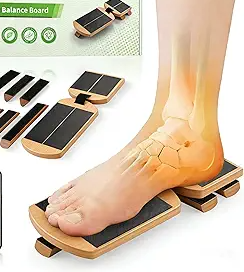
Building a Strong Foundation: Why a Foot Balance Board is Essential for Mobility
In the world of fitness, we often focus on the large muscle groups—the quads, glutes, and core—while neglecting the very foundation of our movement: our feet.1 The human foot contains 26 bones and over 100 muscles, tendons, and ligaments that work in harmony to provide stability. When these “intrinsic” foot muscles become weak due to modern footwear or sedentary lifestyles, it can lead to issues like plantar fasciitis, collapsed arches, and chronic ankle instability.
A balance board designed specifically for foot strengthening is a game-changer for athletes, seniors, and anyone recovering from lower-leg injuries.2
How Balance Boards Target the Feet
Unlike traditional calf raises or toe curls, a balance board introduces controlled instability.3 This forces the foot and ankle to perform hundreds of micro-adjustments per minute to keep you upright.
Waking Up the Intrinsic Muscles
Intrinsic muscles are the small muscles located entirely within the foot. They are responsible for maintaining your arch and stabilizing the toes. By standing on an unstable surface like a wobble board, you engage these “hidden” muscles that rarely get a workout on flat ground.
Improving Proprioception
Proprioception is your body’s ability to sense its position in space.4 After an ankle sprain, this sense is often diminished, making you more prone to future injury. Using a balance board retrains the nerve endings in your feet to communicate more effectively with your brain, allowing for faster self-correction if you trip or step on an uneven surface.
Choosing the Right Strengthener for Your Needs
Not all balance boards are created equal. Depending on your current strength and goals, you should look for specific designs:
- Rocker Boards: These move in a single plane (side-to-side or front-to-back). They are the best starting point for beginners or those in early-stage physical therapy because the movement is predictable and easy to control.5
- Wobble Boards: These feature a circular design with a center fulcrum, allowing for 360-degree rotation.6 These are ideal for advanced foot and ankle strengthening as they challenge the foot from every possible angle.7
- Foot-Specific Boards (like the Mobo Board): Some modern designs feature a “split” or “toe-isolating” platform. These are specifically engineered to force the big toe to engage, which is the key to a strong arch and a powerful athletic “push-off.”
Key Features for Home Use
When shopping on Amazon for a foot strengthener, look for these three non-negotiable features:
- Anti-Slip Surface: Whether you are practicing barefoot or in socks, a textured grip or emery-tape surface is essential for safety.8
- Compact Footprint: Unlike large gym equipment, a good foot balance board should be small enough to slide under a desk or bed.9 This makes it easier to use while you are on a work call or watching TV.
- Adjustable Difficulty: Some boards allow you to change the height of the center piece. A lower height is safer for beginners, while a higher pivot point increases the tilt angle for a more intense workout.
A Simple 5-Minute Routine
You don’t need a long workout to see results. Try this simple progression three times a week:
- Level 1: Two-Legged Balance. Stand on the board with feet hip-width apart.10 Try to keep the edges from touching the floor for 60 seconds.
- Level 2: Controlled Tilts. Slowly tilt the board forward until it touches the floor, then back.11 Repeat side-to-side. Do 15 reps in each direction.
- Level 3: Single-Leg Stance.12 This is the ultimate goal for foot strength. Try to balance on one leg for 30 seconds without letting the board tilt uncontrollably.
Conclusion
A balance board is one of the most cost-effective tools you can add to your home gym.13 By spending just a few minutes a day challenging your stability, you can build a more resilient foundation, improve your posture, and protect your ankles from future sprains.14 It’s a simple shift that pays massive dividends in your long-term mobility.